








 Our Most Read FREE Articles
 Why Our Approach Works
 11 Plus and Cognitive Abilities Tests (CATs)
 Testimonials
 Schools FREE Offer: On-site Workshops
 FACTs Every Parent Should Know
 EasyStreetLearning and Tuition Compared

What's Your Child's 'Learning Style' ?

 Site
Tweet
Site
Tweet
 © EasyStreetLearning.com (GSL)
What Are Learning Styles?
'Learning Styles' theory says that
people learn best when presented with information in a way that suits their specific learning preference.

These days, Learning Styles are covered in every teacher's training programme. At school teachers do their best to ensure lessons have aspects covering each of the different Learning Styles, so every child has a fair chance they can enjoy and understand what is being taught. However, this is not always possible to acheive in a classroom of thirty children.
It makes sense that Learning Styles should also influence the way we help our children at home. It's helpful for us to know what Learning Style suits our children.
There are several Learning Style models, but they all categorise different Learning Styles into a few groups.
We'll discuss these main Learning Styles (from the 'VAK Model' popular with primary school teachers) -
- 'Visual learners' - we'll describe them as "Observers",
- 'Auditory learners' - we'll describe them as "Communicators" and
- 'Kinaesthetic learners' - we'll describe them as "Doers"
Most children don't fit neatly into one category. Children tend to be a mix of these Learning Styles but with one Learning Style tending to be more prominent than the others.
Being aware of Learning Styles also has another welcome advantage. It gives an easy way to make topics that our children find dull more interesting to them.
Our Learning Tracks exploit the different Learning Styles to develop an enthusiasm for learning in all children. For example, by bringing touch into counting makes numbers a relevant concept to children and by using observation to help children make their stories more exciting.
Now, let's look at each Learning Style in the VAK Model in more detail.
Learning Style 1: "Observers"

They can easily understand information when presented in the form of pictures, diagrams, demonstrations, books and TV programmes.
'Observers' might not talk the most, but when they do they usually have something interesting to say based on all the observation and knowledge gathering they do.
'Observers' prefer learning by watching and reading.
Learning Style 2: "Communicators"

'Communicators' are not shy, they effortlessly make friends and can talk freely with anyone.
'Communicators' prefer learning by listening and speaking.
Learning Style 3: "Doers"
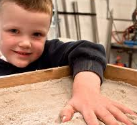
'Doers' have good physical skills. They might be great at catching and throwing balls, dancing and making things.
'Doers' enjoy the moving things more than the static things.
'Doers' learn by 'doing' something rather than listening or watching it.
What Learning Style Suits Your Child ?
This is a great way for you learn more about your child as well as having some fun.
Ask your child if they think each of these these statements apply to them and record their answers on the right. They must answer ALL the questions. Don't worry, there are no right or wrong answers!
Help your child answer the questions by discussing their thoughts behind each question but don't influence them. When finished, click then button to find out what Learning Styles suit your child.
 |  | ||
| 1. | I can correctly describe seven things about my teacher's appearance | ||
| 2. | I enjoy joining in class discussions during lessons | ||
| 3. | At playtime I love to run around rather than sit and chat | ||
| 4. | I think I would rather watch the school play than be in it | ||
| 5. | I enjoy listening to music and I can sing parts of my favourite songs | ||
| 6. | I'd rather have a go at something than talk about it or watch it | ||
| 7. | I rather watch my teacher demonstrate what we had to do than her explain it | ||
| 8. | I enjoy learning from my teacher when she is explaining things in class | ||
| 9. | I find it really hard to be completely still when I am listening or talking | ||
| 10. | If I get a new toy, I'll read the instructions on how to use it before trying it out | ||
| 11. | I often talk or sing when I am playing by myself at home | ||
| 12. |
I really enjoy lessons when we make things | ||
| 13. | I like to write down instructions to help me remember them | ||
| 14. |
If I have to memorize something, I need to repeat it out loud to myself | ||
| 15. | At school, I enjoy learning to do new things in P.E. | ||
| 16. | I can understand maps and can use one in a practical situation | ||
| 17. |
At school, I can happily talk in front of the whole class if my teacher asks me | ||
| 18. | At the weekend, I'd rather go out and be active then play inside all day | ||
| 19. | One of my favourite things to do is read | ||
| 20. |
I can remember least five jokes and enjoy telling them | ||
| 21. | I would enjoy learning a new sport |
Our Learning Tracks Have Aspects Of Each Learning Style
When Learning Styles are combined with fun games this becomes a powerful learning tool for parents to use at home.
In this way we make important life skills such as mental maths fun for your child to master.
Summary
Children learn best when presented with information in a way that suits their specific Learning Styles. Understanding Learning Styles is useful for helping your child.
At home is an excellent place to help your child in ways that suit them. Our Learning Tracks have different Learning Styles incorporated in them, follow them to help your child succeed.
Learning Style Links, References & Books
"Could Do Better!", a book by Phil Beadle, 'Teacher of the Year' and seen in 'The Unteachables'.

Key Articles
Why Our Approach Works
Expert Tuition With Key Differences
What Parents Say

Employers Offer: On-site Workshops
Parents Offer: One-to-One Help
Schools FREE Offer: On-site Workshops
Practical Discipline Techniques That Work
Childcarers: Stand-out by Offering More
What's Your Child's 'Learning Style' ?
Our Charity Partnerships
Learning, School and Your Child
Motivate Your Child To Do Homework
Understanding SATs Result Grading (UK)
FAQs & TestBuster Guides
11 Plus & CAT Tests: Non-verbal Reasoning
11 Plus & CAT Tests: Numerical Reasoning
SAT, 11 Plus and CAT Test Technique
Money Making Parent
 £100's on Private Tuition Fees
PTAs: Raise Money and Offer Discounts
Want to be an EasyStreetLearning Editor ?
FREE Custom Cards (suits invitations)
EasyStreetLearning Blog
Basic Science for Your Child
Advanced Activities for Bright Children
Ways to Teach Children Financial Discipline
Nurturing Confidence in a Shy Child
Building Your Child's General Knowledge
Book Reviews
"Bounce", by M. Syed - Talent 'v' Practice
 Our Charity Partnerships
Discipline Strategies For A Happier Home
FREE Custom Cards
Our Charity Partnerships
Discipline Strategies For A Happier Home
FREE Custom Cards
 Learning Track Guides (to age 12)
11 Plus & CAT Guides and Tests
Succeed at Secondary School Guide
Learning Track Guides (to age 12)
11 Plus & CAT Guides and Tests
Succeed at Secondary School Guide
Parental Support
Tuition
Seminars
© 2012 Gopal Services Ltd | Terms | Privacy | Sitemap | Testimonials | Our Charity Partnerships